

#itsaboutthewholecircuit
The 6Ps™
Where pleasure, passion, and purpose turn a profit. The operator's half of the code, and what it produces. Everyone else treats that as a trade-off. We never have.
Business Hedonism
The word we refuse to surrender
Hedonism has a reputation problem, and we've never been interested in rescuing it for polite company.
The word comes from the Greek for pleasure, and for most of its life it's been used as an accusation: indulgence, excess, the abandonment of seriousness. We use it deliberately, in its older and harder sense.
The pursuit of pleasure is not the opposite of serious work. It is the test of whether the work is worth doing.
We coined the phrase Business Hedonism in Berlin in the early 1990s, in a private club, after the kind of evening that produces more clarity than most boardrooms. It didn't arrive as a doctrine. It named what this circle was already doing: building businesses, enjoying the building, and making money along the way, without treating any one of those as a tax on the others.
Others have bent the phrase into shapes we don't recognise. In some hands it now means perk culture, the retreats and catered lunches that decorate work without changing it. In others it's a warning label for operators who chase the enjoyable tasks and dodge the hard ones. Neither was ever ours.
Business Hedonism, as we defined it and live it, is the deliberate integration of pleasure, passion, purpose, and profit through business, rather than the management of work, wealth, and enjoyment as separate accounts to be balanced against each other.
That's the mindset. What follows is its anatomy.
The operator's three
The inner half of the code
The 6Ps run Passion, Pleasure, Purpose, People, Planet, Profits. The order is the circuit. The first three belong to the operator. They're the inner half of the code, and they're where the mindset lives, because no business outgrows the inner state of the person running it.
Passion is the ignition.
Not enthusiasm, which is borrowed and fades when the context changes. Passion is what you'd defend without being paid, the problems that activate you before there's any reward or any audience. Override it and you don't slow down; you accelerate towards something that isn't yours.
Without passion, success turns to sedation.
Pleasure is the standard.
Not the reward at the end of the quarter, and not the easy path. Pleasure is the quality of experience demanded in the doing of the work, and it's the most reliable signal of resonance a business produces. The old model said tolerate the grind now and enjoy it when you retire, a lie that has cost more operators their health and their best years than any downturn. Work that depletes its operator isn't difficult work. It's a system of quiet betrayal, and clients and teams can feel it from the outside.
Pleasure is not the reward. It is the signal you are aligned.
Purpose is the blade.
Not found on a retreat, and not framed on a wall. Purpose is chosen, declared, and then enforced like a boundary, with consequences attached. It's what holds the course when passion wavers and pleasure dips. A purpose the team can't articulate without checking the handbook isn't a purpose. It's a press release.
Purpose without enforcement is performance art.
The centre
What the inner three produce
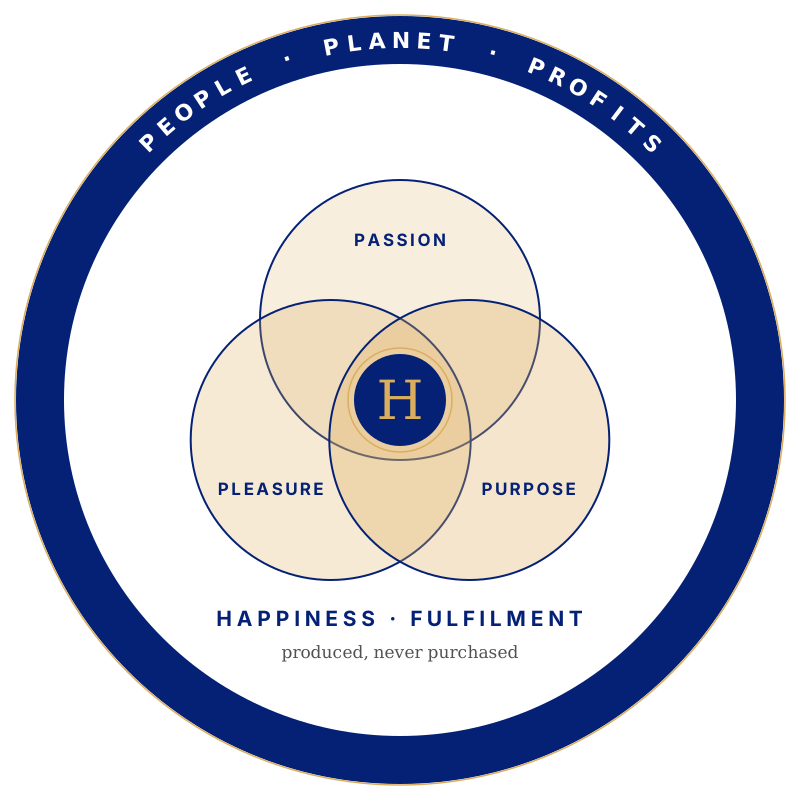
Run the inner three honestly and two things arrive that no adviser can install and no capital can buy: happiness and fulfilment.
Neither is a P, and the distinction is the whole point. They can't be pursued directly, scheduled, or purchased. They're what the inner three produce when they're honoured together.
- Happiness
- Happiness, as we mean it, isn't a mood. It's the sustained state that arises when what you do, what you enjoy, and what you stand for stop contradicting each other.
- Fulfilment
- Fulfilment cuts deeper still: the sense of meaning made, of work that counts for something beyond its invoice.
Chase either directly and they recede. Run the inner three honestly and they arrive as a consequence, the way profit arrives as a consequence of value given.
This is the centre of the mindset, and it's why we reject both caricatures of hedonism. The indulgent hedonist chases pleasure and wonders why happiness never compounds. The grim operator defers pleasure and wonders why the summit feels like nothing.
Both are running broken circuits. The Hedonist Entrepreneur™ runs the whole one.
The outward three
Where the inner state expresses
The inner state doesn't stay inside. People, Planet, and Profits are where it expresses, and they can't be faked from a depleted core. Operators who resent their work build teams that mirror the resentment. Businesses run on deferred living extract from everything around them, because extraction is the only mode they know. And profit, the scoreboard of the whole system, reports with brutal honesty whether the inner three are real or performed.
People amplify.
Your ceiling is set by who you allow in the room, and a mediocre coalition amplifies mediocrity with exactly the efficiency a strong one amplifies performance.
No one scales alone. Everyone bleeds in silence, or in teams.
Planet contextualises.
Sustainability without sanctimony: consequence awareness, and an honest accounting of the residue your decisions leave across time, space and stakeholders.
Your brand becomes folklore, or a cautionary tale. Leave it better than you found it.
Profits validate.
Surplus, and therefore the freedom to choose. Profit is integrity, measured, and it reports whether the inside and the outside of a business agree.
Surplus is not the goal. It is the reward for structural alignment.
The circuit
Break one and the whole system bleeds
Passion ignites, Pleasure sustains, Purpose directs, People amplify, Planet contextualises, Profits validate, and back to Passion.
| The arrangement | What it produces |
|---|---|
| Passion without profit | Lunacy |
| Profit without purpose | Extraction |
| Purpose without pleasure | Martyrdom |
| Pleasure without planet | Destruction |
| Planet without people | Extinction |
| People without passion | Rehearsing death |
The proposition
The art of enjoying business and life
We've spent nearly four decades proving a simple proposition: that the pursuit of pleasure, passion, and purpose marries precisely with the pursuit of profits, and that the operators who integrate them outbuild, outlast, and outlive the ones who keep them in separate rooms.
That's the Hedonist Entrepreneur Mindset. It isn't a permission slip for excess, and it isn't a productivity hack. It's an operating stance: the refusal to treat enjoyment and achievement as rivals, held by people with the discipline to honour both.
We named it decades ago. We've never found a better description of the work.
Questions we get asked
The ones that come up first
- Is this the same as work-life balance?
- No, and the difference matters. Balance assumes two things pulling against each other that have to be traded off. Business Hedonism assumes they're the same system, and that treating them as separate accounts is what breaks operators.
- Where did the phrase come from?
- Berlin, early 1990s, in a private club. It named what a particular circle was already doing rather than proposing something new.
- Why are happiness and fulfilment not Ps?
- Because they can't be operated. The six are functions you can run. Happiness and fulfilment are what running the first three honestly produces, and chasing either one directly is the reliable way to lose it.
- Is there a commercial version of this?
- Yes. The full anatomy of all six, the circuit, and the diagnostic questions live in The 6Ps: The Operating Code, and they are exercised operationally through Manolutions via Total QX™.
The pursuit of pleasure is not the opposite of serious work.
It is the test of whether the work is worth doing.
© The Hedonist Entrepreneur Initiative. Companion to The 6Ps: The Operating Code (Paul Lange, Total QX Framework).